






海浪下的守望:東涌所城的故事
Guardians Beneath the Sea’s Embrace:
Stories of Tung Chung Fort
撰 文 Author Polly
🔊📖 聲音導賞
在明清時,大嶼山為商船前往廣州前的必經之地。而且,自明初起,包括香港在內的沿海地區持續受盜寇侵擾。因此,大嶼山自明清起為廣東及珠江口其中一個重要的海防據點。文章將以東涌所城、東涌小炮台及雞翼角炮台為中心,探討大嶼山佈設的海防設施的重要性,並提出其保育的價值及可行的保育形式。
明初,中國沿海地區接連受倭寇侵擾。廣東最早期的海防部隊始於1394年。為防衛倭寇,洪武二十七年(1394年),明太祖下令在廣東沿岸設立廣東海道,在東莞縣內設立東莞防禦千戶所(即後來的南頭城),及在其東南部設置大鵬守禦千戶所,各有數百名士兵駐守。由於香港屬東莞縣管理的範圍內,香港地區的防衛主要依靠東莞防禦千戶所的兵力。1當時仍未有師船巡海,而沿海地區建築墩台負責瞭望,遇到盜寇入侵,守兵會發出信號,城內駐兵會即時提供防禦。2嘉靖二十九年(1550年),廣東海防制度分為上、中及下路,香港被劃入中路範圍,而且被視為廣州前線堡壘,具有相當戰略地位。在十六世紀七十年代設立官富巡檢司後,這些駐兵便長駐在香港地區。
大嶼山在清初的時候已築有各種防衛軍事設施。清廷於大澳口設有守軍,在山上亦築有雞翼角炮台。根據於道光二年(1822年)成書的阮元《廣東通志》卷一百三十﹒建置六廨署(二)載:「新安縣屬大嶼山,孤懸海外,四面皆水,為各洋船必經之處。內惟大澳口、東涌口二處,可以收泊。其東涌口,向無汛房,惟大澳口額設收兵十三名,山上向有雞翼角炮台,係大鵬營千總駐守。」可證當時外來的船隻會經過大嶼山,而且,道光年前已有雞翼角炮台(即汾流炮台),而當時並未有東涌所城。蕭國健教授曾整理雞翼角炮台的歷史。據汾流鄭氏所述,汾流鄭氏為清初著名海盜鄭連福的後人,鄭連福嘗試以大嶼山為他的巢穴,當時雞翼角炮台亦應被他所佔據。3十九世紀初,大嶼山被張保所佔據,其船隊常據東涌口,而東涌口與汾流距離相近,雞翼角砲台亦有可能被張保佔據。直至嘉慶十五年(1810年),張保向清廷投降,因此清廷能再次佔據炮台。東涌小炮台(即石獅炮台)建於嘉慶二十二年(1817年),原有兵房七間、火藥局一間,但現時未能考究其遺址。
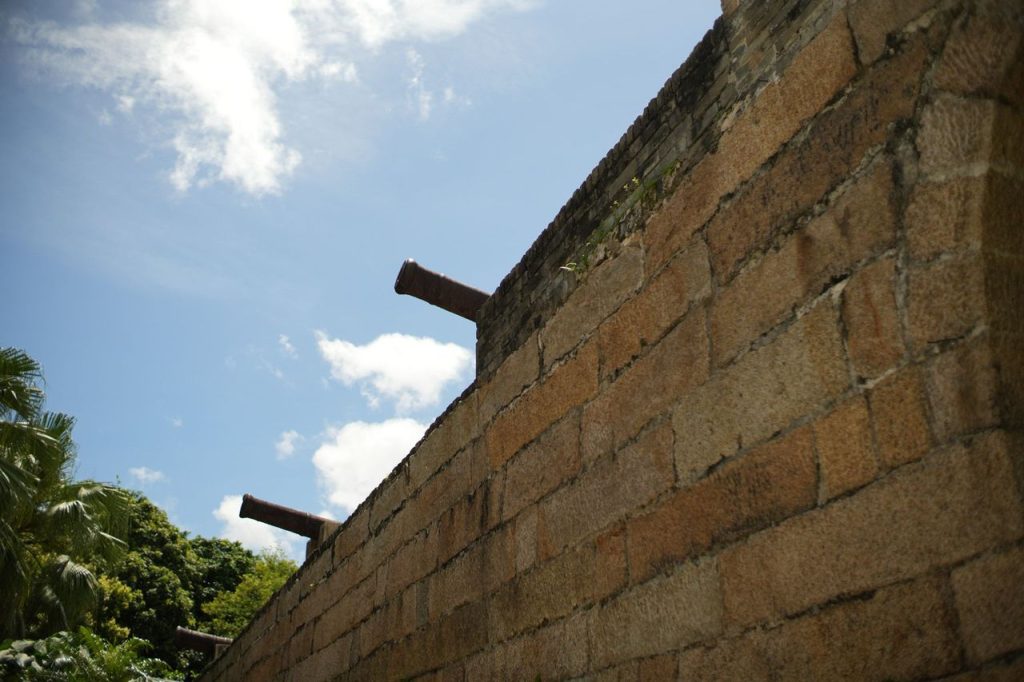
位於上下嶺皮村之間的東涌所城約於1832年建成,4沿大洞山麓所建,長二百五十呎,深二百六十呎,牆高約十呎,正面主牆厚約十五呎。東涌所城主牆上有古砲六門。5根據村民憶述,在十九世紀末,東涌所城的區域有大量盜寇。城內的駐兵並不是本地人,他們會在有盜寇接近時鳴鼓及開槍,嚇退這些盜寇,在平日則表現良好,沒有為本地人造成麻煩。馬灣涌的範圍內亦有軍用船隻,但他們並非處於寨城的控制範圍內。6寨城和馬灣涌在十九世紀末前為東涌的燃料銷售地。7從部分由寨城遠眺寨城外景色的舊照中,我們可見上嶺皮村及未興建逸東邨前之東涌舊貌。1842年,英軍來港時,雞翼角炮台已被荒廢。8東涌所城在及後被用作學校之用,至今為展覽館,展示東涌的歷史及歷史照片,和農業、漁業及日常生活用具。
就着東涌所城的可行旅創方案,我們或可借鏡與東涌所城同類型的海防設施的保育模式,即大鵬守禦千戶所(下稱大鵬所城)。大鵬所城已發展成一個旅遊景點,現時,大鵬所城的建築主體被裝修成為博物館,舉行專題展覽,展示與海防及村落歷史有關的文物及發展脈絡。而且,其佔地面積大,至今已發展成一個供遊人「打卡」、品嘗小吃和購買文創產品的景點。相比之下,東涌所城的主體為昔日的城牆及昔日的學校的建築群,暫時只對外開放城牆及展覽廳,實際上,我們可圍繞城牆沿着所城走一圈,全程約六分鐘左右,路途需要上及下樓梯級,旁邊的圍牆的高度約為腳眼至膝頭之間,南面城牆的路面亦長有少量青苔。若希望全面對外推廣,或需要對城牆進行改裝,令圍牆的高度符合安全要求;或需要加裝無障礙設施,照顧不同使用者的需要。而且,展覽廳外的建築物日久失修,滿佈雜物,清理需時。我們能如何在盡量不改動建築物的原貌,而能夠向公眾推廣東涌所城,鼓勵他們探索所城內的一磚一瓦?除了市集、「打卡」外,能否以故事重演的形式重塑香港在明清時的海防?或者,我們能如何把東涌所城及東涌小炮台扣連至東涌甚至香港的歷史,讓這些海防建設成為敘述的一部份?這些都是可以思考的問題。
During the Ming and Qing dynasties, Lantau Island served as a mandatory passage for merchant ships en route to Guangzhou. Since the early Ming period, the coastal region including present-day Hong Kong had been continuously harassed by pirates. Consequently, from the Ming and Qing dynasties onward, Lantau Island became one of the key maritime defense points of Guangdong Province and the Pearl River Estuary. This article focuses on the Tung Chung Fort, Tung Chung Small Battery, and Fan Lau Fort to examine the importance of Lantau Island’s coastal defense facilities and to propose their conservation value and feasible preservation approaches.
At the dawn of the Ming dynasty, coastal areas of China were repeatedly attacked by wokou (Japanese pirates). The earliest Guangdong maritime defense force was established in 1394. To guard against wokou, in the 27th year of the Hongwu reign (1394), the Emperor ordered the creation of the Guangdong Maritime Route, with the establishment of the Dongguan Defense Qianhu Office (later Nantou Fort) in Dongguan County, and the Dapeng Defense Qianhu Office to its southeast, each garrisoned by several hundred soldiers. Since Hong Kong was under Dongguan County’s jurisdiction, its defense primarily relied on troops from the Dongguan Defense Qianhu Office.
1At that time, there were no official naval patrol ships. Instead, coastal watchtowers were built for lookout purposes. Upon detecting pirate invasions, the guards would send signals to the garrison inside the fort, which would immediately mobilise to defend. 2In the 29th year of the Jiajing reign (1550), Guangdong’s maritime defense system was divided into Upper, Middle, and Lower Routes. Hong Kong fell under the Middle Route and was regarded as a frontline fortress for Guangzhou, holding strategic significance. After the establishment of the Guanfu Inspection Office in the 1570s, the stationed soldiers were permanently based in Hong Kong.
By the early Qing dynasty, various military defense facilities had been constructed on Lantau Island. The Qing government stationed troops at Tai O Harbour and built the Fan Lau Fort atop the hills. According to Ruan Yuan’s General Records of Guangdong (Guangdong Tongzhi), volume 130, compiled in the second year of Daoguang (1822), “Xin’an County includes Lantau Island, isolated overseas surrounded by water on all sides, a mandatory passage for foreign ships. Only Tai O Harbour and Tung Chung Harbour provide anchorage. Tung Chung Harbour previously had no garrison station; only Tai O Harbour stationed thirteen soldiers. The Fan Lau Fort on the hill was guarded by the Dapeng Camp’s military commander.” This confirms that foreign ships passed Lantau Island, and that by Daoguang’s reign the Fan Lau Fort was already built, while no Tung Chung Fort existed at that time.
Professor Siu Kwok-kin has researched the history of the Fan Lau Fort. According to the Fenliu Zheng family, descendants of the famous early Qing pirate Zheng Lianfu, Zheng attempted to use Lantau Island as his base, and the Fan Lau Fort was likely occupied by him. 3In the early 19th century, the pirate Cheung Po Tsai took over Lantau Island; his fleet frequently operated out of Tung Chung Harbour. Given the proximity between Tung Chung Harbour and Fenliu, the Fan Lau Fort may also have been under Cheung’s control. In the 15th year of the Jiaqing reign (1810), Cheung Po Tsai surrendered to the Qing court, allowing imperial forces to reclaim the battery. The Tung Chung Small Battery was built in the 22nd year of Jiaqing (1817), initially comprising seven barracks and one gunpowder magazine, though its exact site is no longer ascertainable.
4The Tung Chung Fort, located between the villages of Sheung and Ha Ling Pei, was constructed around 1832 along the foothills of Tai Tung Shan, with walls ten feet high and fifteen feet thick. The fort housed six specialised artillery batteries and had a larger garrison than other contemporary fortifications. 5According to villagers’ recollections, by the late 19th century, the fort area experienced heavy pirate activity. The garrison troops were not locals; when pirates approached, the guards would beat drums and fire shots to drive them away. During normal periods, they behaved well and caused no trouble to residents.
Military vessels were also present around Ma Wan Chung but were not under the fort’s direct control. 6Before the end of the 19th century, Ma Wan Chung and the fort served as fuel selling areas for Tung Chung. 7From some old photographs taken from inside the fort looking outward, one can see the village of Sheung Ling Pei and the old appearance of Tung Chung before the construction of Yat Tung Estate. In 1842, when British forces arrived in Hong Kong, the Fan Lau Fort was already abandoned. 8Subsequently, Tung Chung Fort was used as a school and today functions as an exhibition hall displaying Tung Chung’s history and fisheries tools.
Regarding feasible tourism and conservation proposals for Tung Chung Fort, one might reference conservation models of similar coastal defense sites, such as the Dapeng Defense Qianhu Fort (hereafter “Dapeng Fort”). Dapeng Fort has evolved into a tourist destination; its main structures have been restored into a museum which holds thematic exhibitions on maritime defense and village history, displaying historical artifacts and development context. Additionally, its large area has become a scenic spot frequented by visitors for photography, local snacks, and creative products. By contrast, Tung Chung Fort mainly consists of remnants of its former walls and the old school buildings, currently only open to the public for the walls and exhibition hall visits. Visitors can walk around the fort walls in approximately six minutes; the route involves stairs both up and down, with the adjacent wall height ranging roughly from ankle to knee level, and some moss growth on the southern wall path.
For fully opening the site to the public, modifications might be needed to raise the wall height for safety, and to install barrier-free facilities to accommodate various visitors. Moreover, the buildings outside the exhibition hall have deteriorated and are cluttered, requiring significant cleaning and restoration efforts. How might promotion of Tung Chung Fort be achieved while minimising alterations to its original appearance, encouraging public exploration of every brick and tile? Apart from markets and photo spots, can historical reenactments be used to revive the story of Hong Kong’s maritime defense in the Ming and Qing periods? How might Tung Chung Fort and the Tung Chung Small Battery be connected to the broader history of Tung Chung and Hong Kong, making these fortifications part of a comprehensive narrative? These are important questions for consideration.
參考資料 References
1霍啟昌,〈十九世紀以前的香港〉,收入王賡編,《香港史新編(增訂版)》(香港:三聯書店有限公司,2017),頁43-48。
2蕭國健,《香港之海防歷史及軍事遺跡》(香港:中華文教交流服務中心,2006),頁6-8。
3蕭國健,《清代香港之海防與古壘》(香港:顯朝書室,1982),頁15-17。
4蕭國健曾於東涌所城進行田野考察。他曾對拱門上的文字進行研究,並指東涌所城應為道光十二年建成。詳細可參考:Anthony K. K. Siu,“More about Tung Chung Fort”Journal of the Royal Asiatic Society Hong Kong Branch, 22 (1982), pp. 305-307.
5蕭國健,《清代香港之海防與古壘》(香港:顯朝書室,1982),頁19-23。
6James Hayes,“The Tung Chung Fort (Lantau Island, Hong Kong)”Journal of the Royal Asiatic Society Hong Kong Branch, 8 (1968), pp. 165-167.
7Patrick H. Hase, Village and Market Towns in Hong Kong: Settlement and History (Hong Kong: The Chinese University of Hong Kong Press, 2024), pp. 131.
8蕭國健,《清代香港之海防與古壘》,頁15-17。